My first impression was grey. The tall block of flats on the Seymour hill estate in Belfast; my new home on the fortuitously numbered ‘Twelfth’ floor loomed high above, a slightly darker shade than the sky. The red, white and blue kerbstones provided the only colour and my Zimbabwean childhood seemed very far away. I learnt early on not to trust first impressions. Over time my eyes adjusted and I saw other hues, and when the sun shone just how magnificent everything was. I was grateful for this place, for my new home, for the opportunities I now had but mostly I was struck by the kindness of strangers. When I got the bus to school people would ask after my grandmother, comment on the weather, quiz me on what Africa was like. One time, when I was in First year, a man who was drunk followed me up to my seat and sat next to me mocking in a loud, exaggerated accent, how I’d said “Excuse me” when I passed by him. He scared me and I started to cry. Two elderly women told him he should be ashamed of himself and the bus driver stopped the bus and made him get off. One of the women held my hand all the way to my stop, getting off with me.
A few years later we moved to the mixed Ormeau Rd, which I naively thought reflected more my experience and outlook, until much later when a chance encounter with a Fermanagh man outside the ‘Duke of York’ changed everything.
The Belfast pub, most notable for its murals and insta-worthy suspended umbrellas, was where I first met Fergal Sherry. Like so many Irishmen, he was as argumentative as he was charming, and I loved him immediately. It was many weeks before I would see him again because he was always at Gaelic football training or matches. An amateur sport I had hardly heard of, I assumed he was just avoiding me, until I discovered almost nothing comes between Gaelic Football and anything else. Declining an invitation to a wedding is fine if there has been a birth, a death or if a match is scheduled the same day (the latter arguably the most acceptable.)
I knew he liked me when he brought me to a match to watch him play. I had heard of red cards and yellow cards, but not black cards. When I asked about the one he received during that first match, he told me these were issued when a player was too good and had to be replaced with someone less talented in order to restore balance – and nothing at all to do with that ‘conversation’ he’d had with the linesman…
County flags were another novelty. Somehow by now I had lived more of my life in Northern Ireland than out of it and yet was completely oblivious to county insignia. I had also never heard of Croke Park. This is not a place, it’s a pilgrimage. I made the mistake of asking after we were married what the best day of Fergal’s life was, curious as to which of our many milestones ranked highest. In that honest space somewhere between awake and sleep he murmured 2004, the day Fermanagh beat Armagh. The birth of Jesus gave rise to B.C. and A.D. – Fermanagh’s run that year became a similar time marker from which all events are measured.
A few years after I was elected to Belfast City Council he decided he would finish his career at “home”. Hours on the road to training, back to Belfast for work, down again for matches seemed madness to me – but when I mentioned this to any GAA person it was acknowledged with a solemn nod of respect; that was how it should be.
We’d been married in Clones, home to St Tiernach’s Park, the stadium Arlene Foster and the late Christopher Stalford attended to watch Fermanagh play Donegal in the 2018 Ulster Final. I was there that day, green and white entwined wool wrapped around my head. The welcome they received was warm and the hope was palpable. That day felt like a new beginning for Fermanagh perhaps, and political attitudes here.
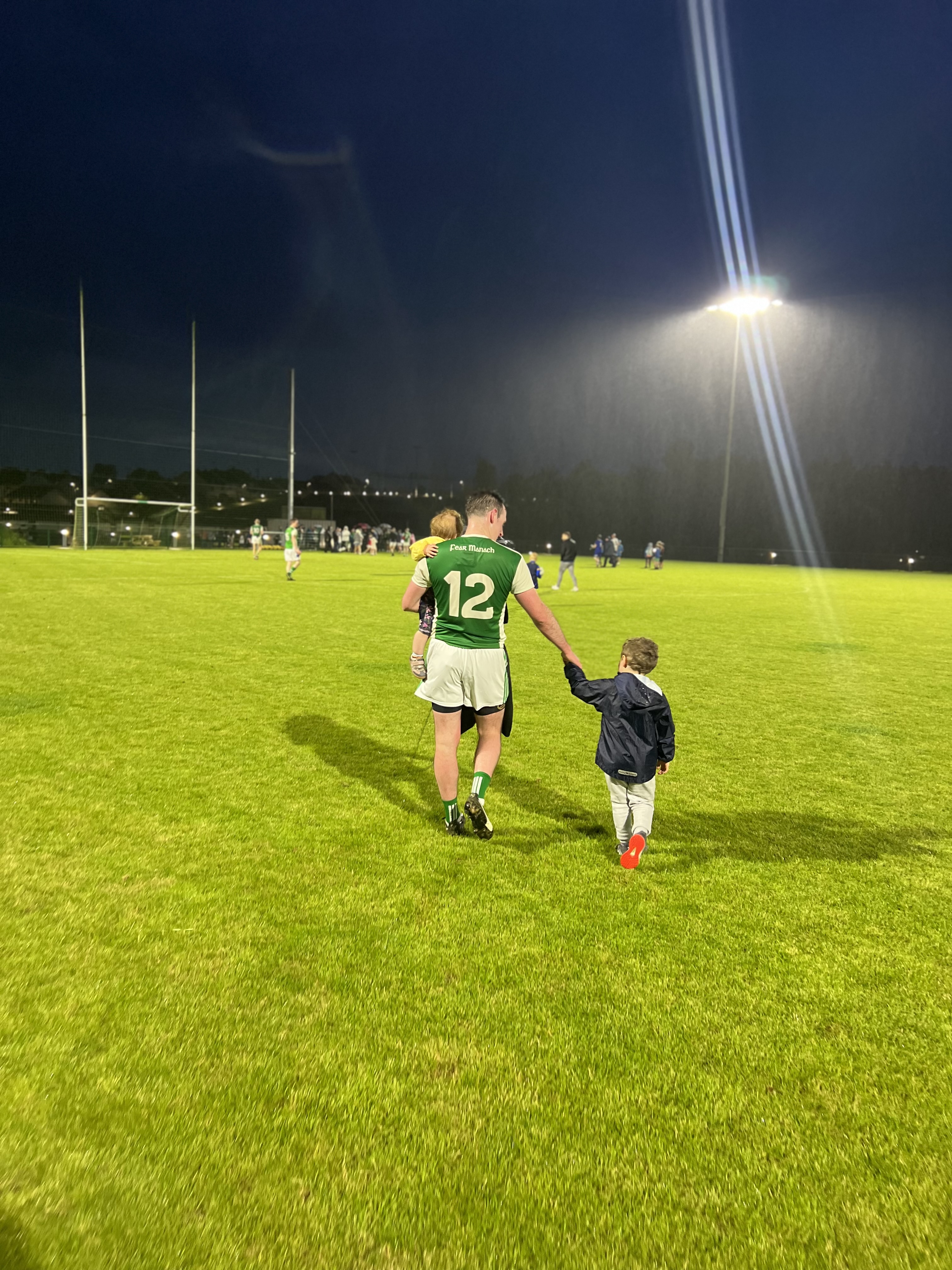
The year Aghadrumsee won the Junior Championship and reached the Ulster semi-final was the year I learnt I could go half an hour without breathing. When I became the Lord Mayor of Belfast the commute became difficult for Fergal and impossible after our second child was born and I was now an MLA. Despite having threatened to retire since I met him, Fergal plays when he can for St Brigids in South Belfast; a GAA home from home. As the time draws closer I begin to feel what it will mean to him to hang up his boots. The GAA isn’t just a hobby, it’s not just a sport, it’s been a way of life. It’s community.
Someone commented on Twitter (I don’t think I ever will be able to call it ‘X’) how astonishing it is that I lived in Belfast since I was 12, yet my first experience of the GAA was when I met Fergal in my 20s. They’re right. Other comments suggested my ‘true colours’ had been revealed – and I don’t think they meant in terms of the green and white of Fermanagh. I didn’t come from this place – this culture. But its mine now. That doesn’t mean I’m choosing. As a politician my greatest hope is that our children will have a future where all aspects of the varied culture here can be embraced and respected – and despite the political dysfunction there are examples of us moving that way, all around us.
I know what I have experienced as a latecomer to the GAA, the joy it has given me. I am so glad my children will grow up to value a sport which at its core is about people. And as a wife and mother I’m also glad my two got to see their brilliant dad in action (as part of a ‘Fermanagh legends’ team no less!), and one day I fervently hope they’ll share in the same joy with theirs.
First published in the Impartial Newspaper August 2023
 Kate Nicholl